

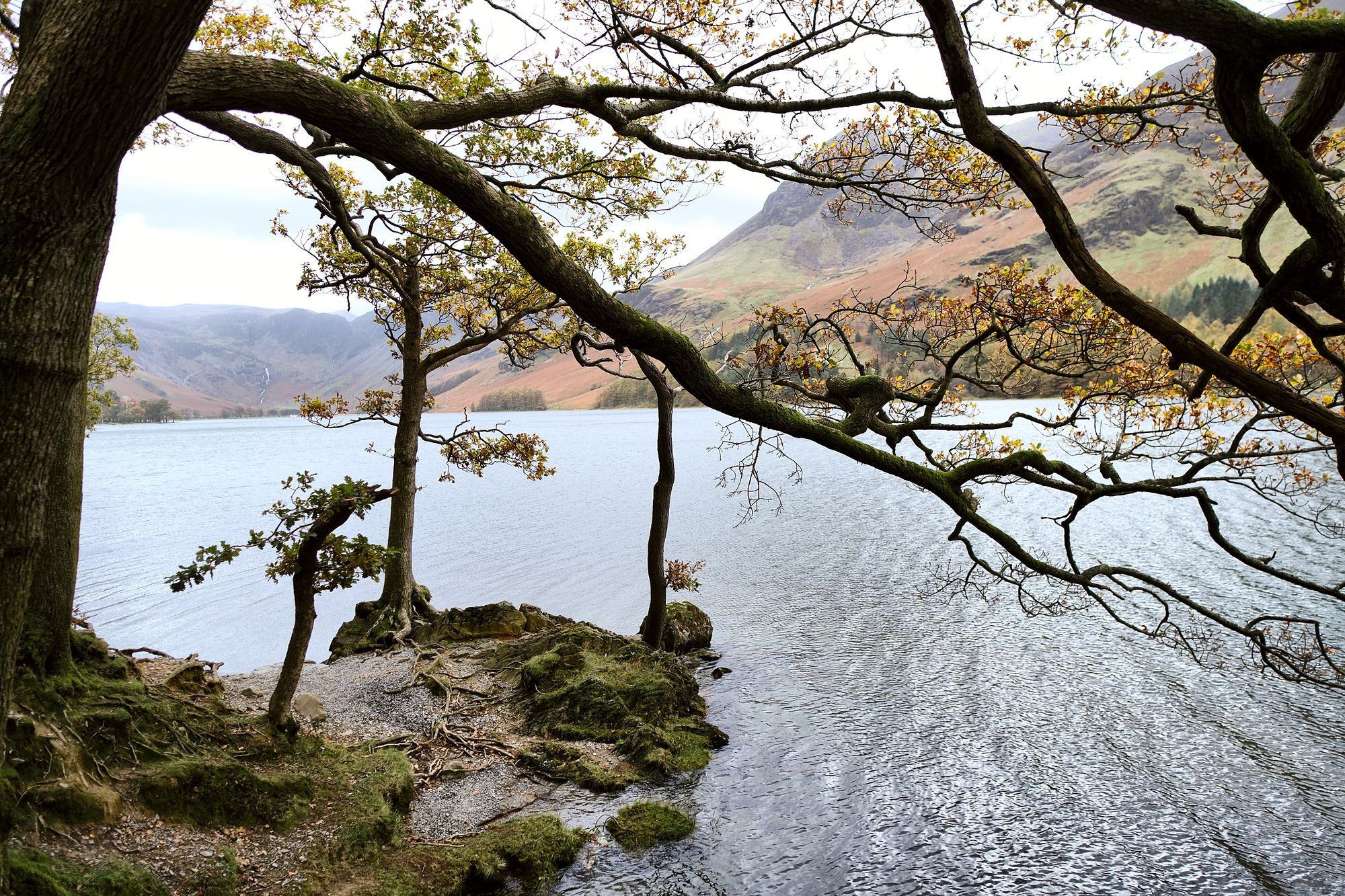
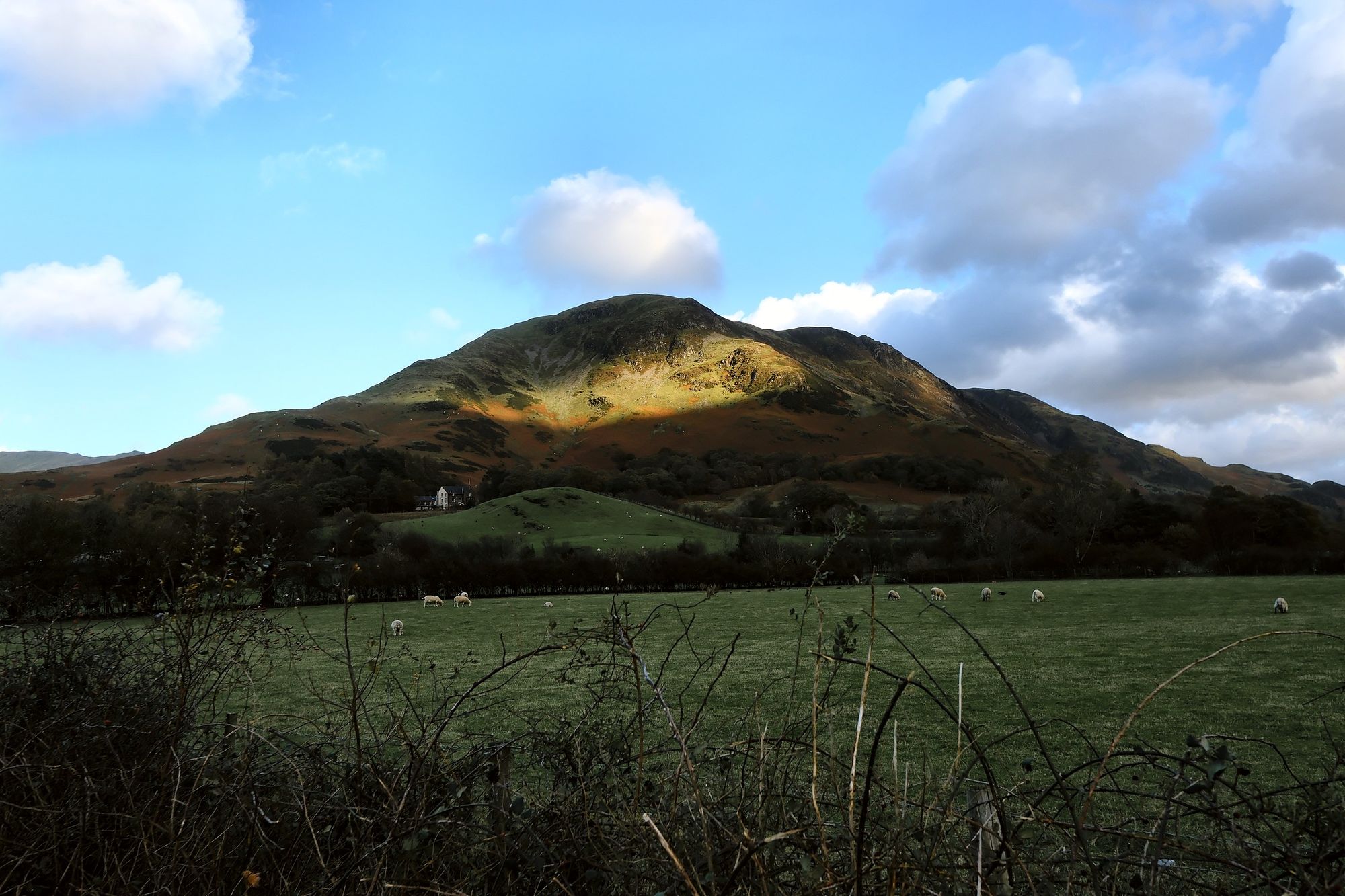
Buttermere, that picture-perfect reflective lake, or ‘mere’, has long been a first-choice favourite for Lake District walks. Stunning any time of year, and nearly all weathers, its good paths and regular refreshments make it manageable with children and – perhaps most wonderfully – the walk sits in a ring of fantastic fells. Stand at the edge of the village and look up the lake and you’ll see Robinson’s long flank on the left; the High Stile ridge rising almost straight out of the water on the right. At the far end stand Fleetwith Pike and the beautiful Haystacks, which was Alfred Wainwright’s favourite climb. And behind you, rises Grassmoor and Whiteless Pike. The walk circles the mirror-still water and the fells tower around the whole walk. What more can you ask for?
I like to go clockwise. That means tea and cake or award-winning ice cream at Syke Farm first, then through the farmyard and down across fields dotted with Herdwick sheep to the shore, where the water runs gin clear over stone. The path then follows the lake under Robinson, runs through a tunnel cut in the rock and over a shingle beach made for skimming stones, before reaching Gatesgarth beneath Fleetwith Pike. Then it’s a gorgeous stroll home along the far shore through Burtness Wood, with the fells you walked under an hour ago now across the water. On this side, waterfalls stream down the fell sides the colour of milk and red squirrels can be glimpsed in the larches.
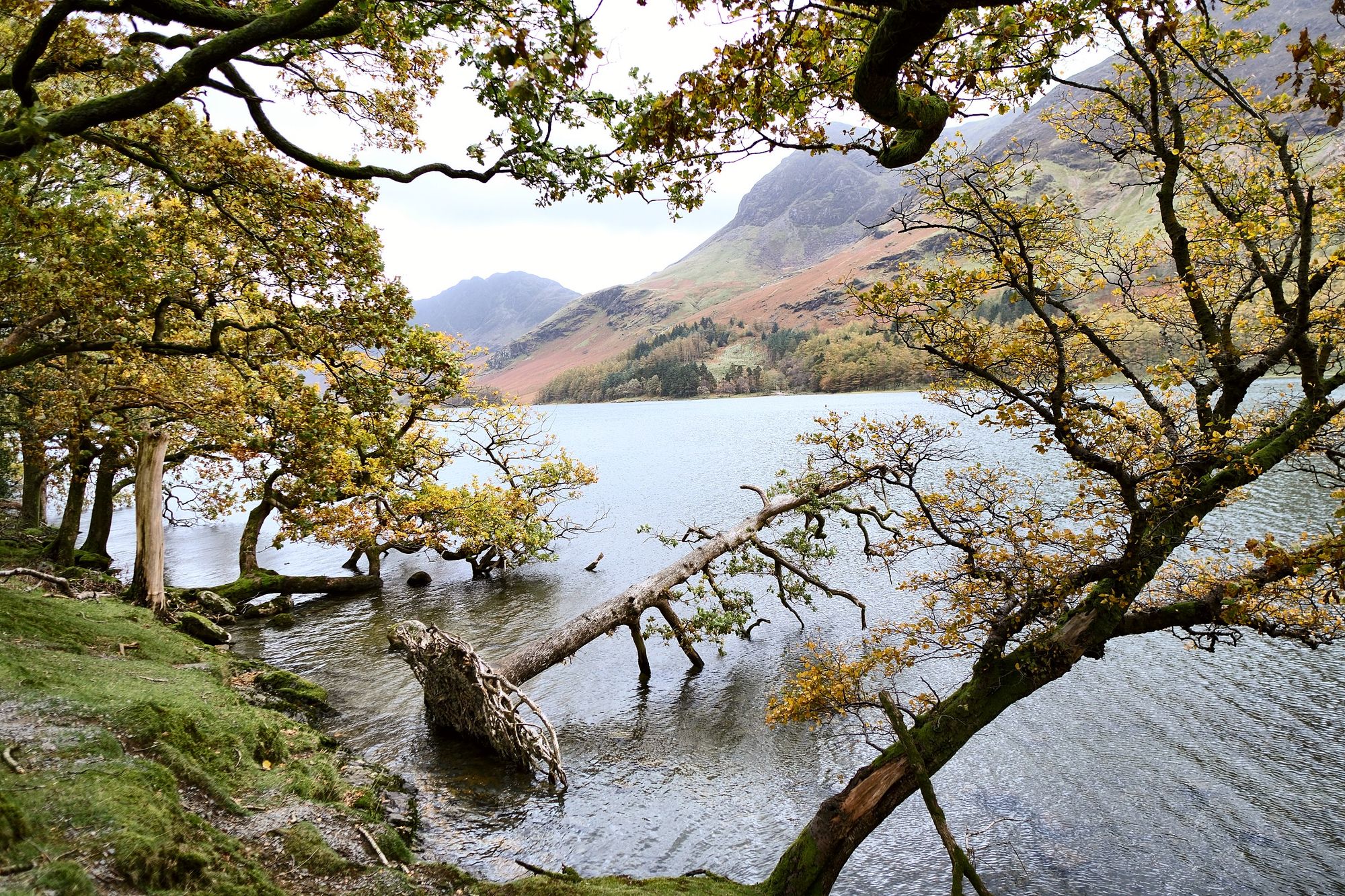
I walked the route in autumn, when it is unmatched in terms of beauty and when the bracken had turned copper, the larches gold and the sun came and went through big clouds, bathing the fellsides in sun. In all, it is about five miles of good walking with hardly any inclines and it usually takes a couple of hours in total. But no one should try it without the obligatory and well-earned pint of Jennings Cumberland Ale at The Bridge, the historic and atmospheric pub a few steps from the lakeshore.
This guide covers everything you need: the route step by step, how long it takes, parking and buses, which way round to go, where to swim, paddle and skim stones, dogs, pushchairs, food and the pint at the end.
The walk around Buttermere at a glance
Distance
About 5 miles (8 km) from the National Trust car park, as I walked it. The lake circuit alone is 4.5 to 4.75 miles (7.2 to 7.6 km), depending on whose guide you read.
Time
2 to 3 hours with stops. Longer if you eat or linger. Which you definitely should.
Ascent / descent
Very little. About 70m in total.
Terrain
Graded paths, woodland and shore; some rough, stony sections. One rock step where you may want your hands and a short rock tunnel; about 10 minutes on a lane. Boots and wellies needed on wet days but fine in trainers on drier occasions.
Start and finish
National Trust car park, Buttermere village, CA13 9UZ (what3words ///promises.parsnips.smoker). Free for members.
Direction
Clockwise, via Syke Farm. It works just as well anticlockwise (see below).
Food and drink
Syke Farm Tearoom at the start, a seasonal café at Gatesgarth halfway, the Bridge Inn at the finish for beers.
Toilets
National Park car park behind the Bridge Hotel, with an accessible toilet.
Map
OS Explorer OL4, The English Lakes North-western area.
Bus
Honister Rambler 77 / 77A from Keswick, seasonal, roughly Easter to the start of November.
Dogs
Welcome, on a short lead near sheep and through Gatesgarth Farm.
Pushchairs and wheelchairs
The first stretch from the village only (see below).
The pint
Jennings Cumberland Ale (4.0%) at the Bridge Inn, a few minutes from the car park.

How long is the walk around Buttermere?
The lake circuit is 4.5 to 4.75 miles (7.2 to 7.6 km). Start from the National Trust car park and add the walk up to Syke Farm, as I did, and you're at about 5 miles (8 km).
The walking alone takes at least 1 hour 40 minutes. Most people take 2 to 3 hours, and the National Trust suggests allowing 3. I'd allow the full three as the stops are half the point.

Why Buttermere is the perfect Lakes walk
It's perhaps the easiest complete lake circuit in the Lake District. You stay close to the water almost the whole way, on good, established paths, and you never have to climb anything.
There's ice cream at the farm (or a lovely selection of tea and cakes if it’s a bit chillier) at the start and a historic pub at the end, The Bridge, where Queen Victoria stopped by in 1850.
The fells close in on every side giving the most scenic and stunning backdrops. The High Stile ridge above the south-west shore, Fleetwith Pike and Haystacks at the head of the valley, Robinson to the north-east and the Grasmoor fells behind the village.
Parking is easy by Lake District standards, with the National Trust car park right in the village. And wherever the path touches the shore, the water is wonderfully clear. There are places to dip, paddle, swim and skim stones all the way round, so bring a towel.
The Buttermere circular walk, step by step
1. Car park to Syke Farm
From the National Trust car park, walk into the village past the Bridge Hotel and follow the road uphill, passing the small white church hall on your left. Syke Farm is on your right. The tearoom is through the left-hand of the two farm entrances.
Syke Farm is a working farm, and its ice cream is made from the milk of its own herd of Ayrshire cows. Buttermere's name is usually read as "the lake by the dairy pastures", so an ice cream here is close to the point of the place. The tearoom also does cakes (including gluten-free and vegan), lunches and packed lunches if you order before 11am.
Before you leave, look into St James' Church, just above the farm. It was built in 1840, and inside is a plaque to Alfred Wainwright by a window that looks out to Haystacks, where his ashes were scattered.
2. Syke Farm to the shore
Go through the farmyard and follow the path down across the fields towards the lake. It bends left, crosses a footbridge over the beck and runs through a small stand of trees to the shore. Follow the shore path with the lake on your right. It stays on your right almost all the way round.
Where the path meets the water, the lake is gin clear over stone. It stays like that the whole way round.
From 1 April to 30 June, a short permissive stretch of shore path at the north end of the lake closes so common sandpipers can nest on the gravel. Follow the signed diversion.
3. The north-east shore and the Hassness tunnel
Follow the path south-east along the shore towards Hassness, through woodland and along the water's edge. It runs into the Hassness tunnel, cut through a rock outcrop and long enough to be dark in the middle. The National Trust dates it to the 19th century and credits a Manchester mill owner. Coming clockwise, it's one of the first things you reach.
4. Crag Wood, the shingle bank and the road
Beyond the tunnel, the path goes through a gate, over a bridge and round Crag Wood, then follows a shingle bank round the promontory. The shingle here is made for skimming stones.
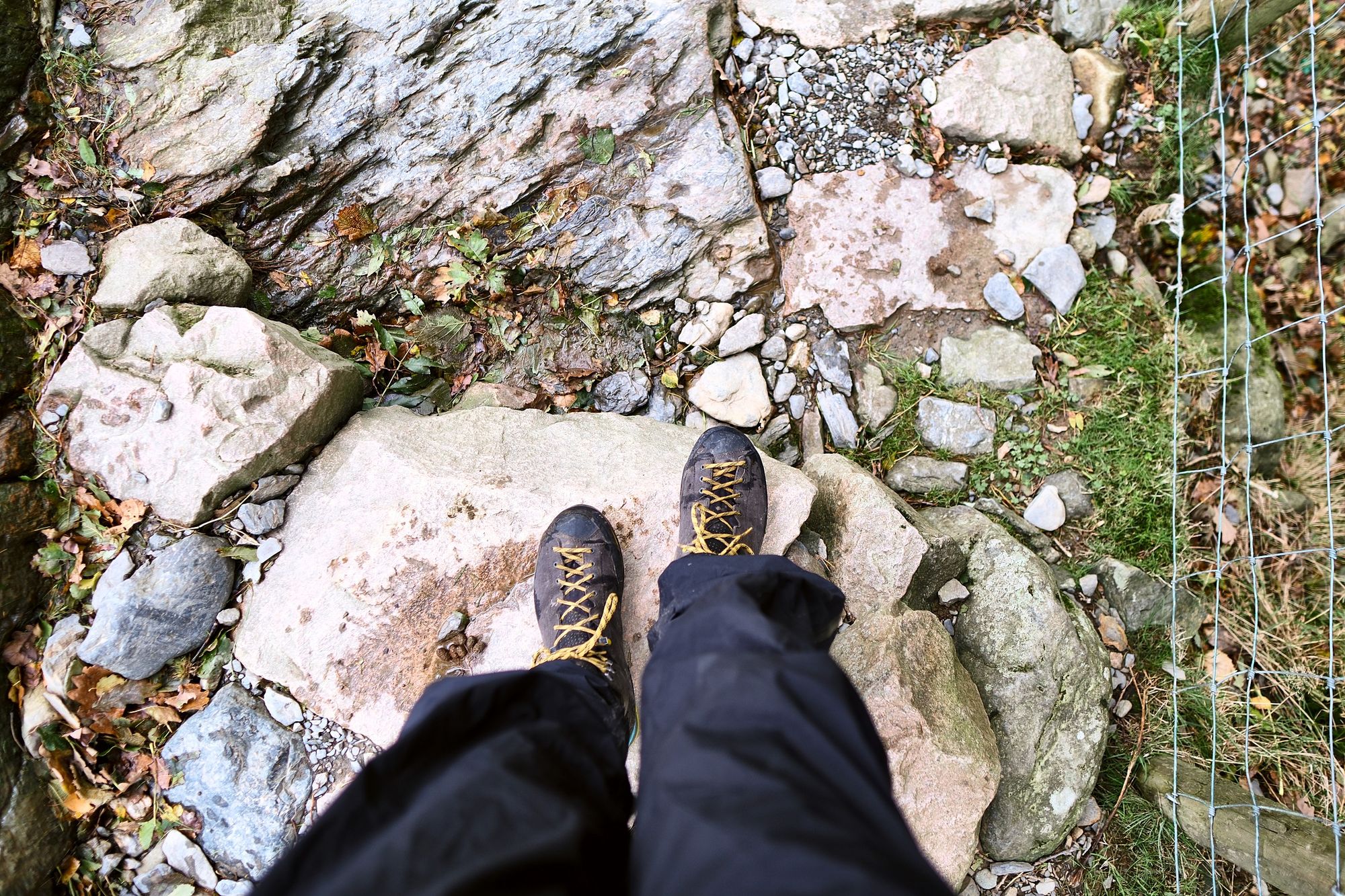
On this side of the lake there's one short rock step where you may want to use your hands. The shore path then climbs up to the road. Turn right and follow it for about 10 minutes, over a slight rise, to Gatesgarth Farm. Traffic is light, but keep children and dogs close.

5. Gatesgarth and Peggie's Bridge
Gatesgarth is halfway. There's a small seasonal café for tea, coffee and ice cream, a car park, a bus stop and the base of the Cockermouth Mountain Rescue Team. If anyone's legs have had enough, the Honister Rambler service stops here.
Turn right through the farmyard and follow the track across the flat fields at the head of the lake, with Fleetwith Pike and Haystacks standing over the valley. Cross Peggie's Bridge, go through the gate and turn right along the south-west shore.
6. Burtness Wood
For a little over a mile (2 km), the path runs through Burtness Wood with the lake on your right. For me, it's the best part of the walk. A graded path under larch and pine, rising and dipping over big stones in places, with gaps in the trees that frame the fells across the water, Robinson, Hindscarth and Dale Head among them.
Small stony beaches open off the path all the way along. They're the easiest places on the walk to paddle or swim. Streams come down off the High Stile range to meet the lake in powerful, photogenic torrents after heavy rain.
7. The foot of the lake and back to the Bridge
The wood ends at the foot of the lake, by the National Trust field. Turn round here for the epic views back up the lake to Fleetwith Pike. The water leaves the lake here as Buttermere Dubs, on its way to Crummock Water.
Cross the footbridges (which are also great photo sites), go through the gate and follow the field edge and then the fenced lane through a run of gates towards the village. Ignore the track signed for Scale Force, which heads for the waterfall above Crummock Water. The lane brings you out beside the Buttermere Court Hotel, a few steps from The Bridge Hotel and the car park.
The Buttermere Court was the Fish Inn until 2019, and in 1802 it was home to Mary Robinson, the landlord's daughter, already famous from travel writing as the Maid of Buttermere. That year she married a charming visitor calling himself Colonel Hope. He was John Hatfield, a bigamist and impostor. Coleridge wrote up the wedding for the Morning Post. The truth came out, and Hatfield was hanged at Carlisle in 1803. Wordsworth put Mary in The Prelude; Melvyn Bragg made a novel of it in 1987.
"Follow the path south-east along the shore towards Hassness, through woodland and along the water's edge. It runs into the Hassness tunnel, cut through a rock outcrop and long enough to be dark in the middle. "

Clockwise or anticlockwise?
Both work, and the guides split. The National Trust goes anticlockwise: woods first, tunnel on the way home. But I always tend to go clockwise. The path from Syke Farm leads to the north-east shore, so the ice cream comes first. It also saves Burtness Wood for last, when the afternoon sun is on the fells across the water, and it ends at the Bridge.
To go anticlockwise from the car park, walk to the Buttermere Court Hotel and take the bridleway signed for the lake past the front of the hotel. After about 200 m, ignore the track signed for Scale Force and follow the lane through the gates to the National Trust field. Turn right along the field edge, cross two footbridges and pick up the shore path into Burtness Wood, with the lake on your left.

Buttermere in autumn
I'd walk this in any month. Autumn is when it's exceptional. The bracken on the fellsides turns copper and rust and the larches in Burtness Wood go gold. On a day of sun and cloud, the light picks out one fellside at a time while the next sits in shadow. It changes by the minute. Bring a camera.
Plan for short days. In late autumn the light goes in the late afternoon and in midwinter the sun is down before four, so make sure to set off by lunchtime.
Spring brings lambs, of course, and the Rannerdale bluebells are just over the hill. Summer is busiest so arrive early for parking and space and pack enough water.

The well-earned pint of Jennings
With the walk fresh under the belt, nothing beats the well-earned beer. A ritual of the Lakes. The Bridge is the slate-fronted inn in the middle of the village, and the walk starts and ends a few steps from its door. Its bar is the Walkers Bar, named for the Reverend Robert Walker, who founded the inn in the 1730s. A plaque inside tells the rest in one sentence. The house, "founded by 'Wonderful Walker' in 1735", was briefly renamed the Victoria "in compliment to her late Majesty and the Prince Consort when they were entertained here in 1850". But it's The Bridge again now.. until the next royal visits.
On the bar is Jennings Cumberland Ale and I took mine to a table by the window. Cumberland is Jennings legendary deep golden ale at 4.0%, brewed with Maris Otter malt and a dash of chocolate malt for colour, and hopped with Fuggles, Goldings and Challenger. It's biscuity, with a fruity, gently spicy hop aroma. After five miles round the lake, it's the perfect beer at the pefect strength.

There's also a golden thread from Buttermere to the beer in the glass. The water you've walked beside leaves Buttermere at the Dubs, runs through Crummock Water and becomes the River Cocker, which winds down the Lorton Vale to Cockermouth and meets the Derwent at the foot of the castle, beside the Jennings brewery. The beer itself is brewed with Lakeland spring water from the brewery's own well, sunk in 1884.
If you want to try the whole range, the Jennings taproom at the Castle Brewery in Cockermouth is about ten miles down the valley and open seven days a week. A good reason to bring a designated driver, or take the bus and leave the car at home.
Parking for the Buttermere walk
- National Trust car park: beside the Buttermere Court Hotel, CA13 9UZ, ///promises.parsnips.smoker. Free for National Trust members; others pay, so carry coins or use the JustPark app. No overnight parking.
- Lake District National Park car park: behind the Bridge Hotel, CA13 9XA, with the toilets.
- By St James' Church: a little free roadside parking. It fills early.
- Gatesgarth Farm: at the head of the lake, if the village is full. Join the loop there.
Both village car parks fill early on summer weekends and bank holidays. Don't park on the verges; the lanes are narrow.
From Cockermouth, the road runs up the Lorton Vale and along Crummock Water to Buttermere, keeping company with the River Cocker most of the way. From Keswick you can come over Newlands Hause, or through Borrowdale and over Honister Pass. Both are steep and narrow.

Buttermere walk FAQs
How long is the walk around Buttermere? The lake circuit is 4.5 to 4.75 miles (7.2 to 7.6 km); from the National Trust car park via Syke Farm it's about 5 miles (8 km). Allow 2 to 3 hours.
Is the Buttermere circular walk easy? Yes. It's mostly level on good paths, with some rough sections, one short rock step and a short tunnel. Most families manage it comfortably.
Where do you park for the Buttermere walk? The National Trust car park in the village (CA13 9UZ) or the National Park car park behind the Bridge Hotel (CA13 9XA). Gatesgarth Farm, at the head of the lake, is the back-up.
Which way round Buttermere should you walk? Either. The National Trust goes anticlockwise. I went clockwise from Syke Farm, for ice cream first and Burtness Wood last.
Can you swim in Buttermere? Yes, wild swimming is allowed. The lake is deep (23 m), cold all year and has no lifeguards, so swim with someone and take care.
Is there a tunnel on the Buttermere walk? Yes. The Hassness tunnel is a short passage cut through the rock on the north-east shore in the 19th century.
Can you walk around Buttermere with a dog? Yes, on a short lead near sheep and through Gatesgarth Farm. The Walkers Bar at the Bridge Inn is dog friendly.
Is the Buttermere walk suitable for pushchairs or wheelchairs? Only the first 750 m from the village, on Miles without Stiles route 25. The full loop has a rock step, rough ground and a tunnel.
Where can you get food on the Buttermere walk? Syke Farm Tearoom at the start, a seasonal café at Gatesgarth halfway and the Bridge Inn at the finish.
Where can you get a pint after the Buttermere walk? The Bridge Inn in Buttermere village pours Jennings Cumberland Ale, a few minutes from both car parks.
Can you get to Buttermere by bus? Yes, the Honister Rambler 77 / 77A from Keswick, in season (roughly Easter to the start of November).
When is the best time to walk around Buttermere? Any time of year. Autumn, for the colour, is the best of it.


